
Death Trip, Interstate 80
Confronting family secrets and driving into the vanishing point of the Midwestern landscape.

This is a true story. To read more about my family’s crime, go here and here.
On a pitch-dark morning striking toward August’s close, we packed our duffels, fueled up at a nearby gas station, and disappeared into the Corn Belt. Phil and I had crossed straight through Nebraska’s windblown expanse together a handful of times before. The road stays the same, but my life had changed: my grandfather was dying. My parents telephoned: “If you want to see him, you should come home now.” Death’s door flung open and on the other side of it was an eternal stretch of asphalt between us.
My grandpa was primordially haunted, a victim of violence and tangled family webs. In 1942, his mother murdered his father in their farmhouse while he and his brother slept in the next room. She abandoned the two of them in a muddy, rain-soaked cornfield, scolding the youngest, “You quit that crying or I’ll kill you.” A massive manhunt was issued, and when the police discovered her ten days later, she signed the confession papers.
He wanted nothing more than to rebuild around the wound that tragedy burned into him, but couldn’t escape. When his grandfather-turned-guardian suffered a heart attack four years after the murder, the family propped up his corpse in a pine coffin inside the kitchen before the funeral. My grandpa saw his ghastly face and pallid skin and said it changed him forever. Ever since that moment he thought the “spooks” were out to get him.
This was the legacy I lingered on as we climbed sloping fields on the long road called nowhere. Anticipatory grief was butterflying, splitting in half from end to end, leaving me in two. I was in a state of mind, pausing on the reflected windows of passing cars and people who populate nowhere. Their lives, tragedies large and small.
In the sorrowful swathes of Nebraska, I wept a lot. There must be a word for missing someone before they’re gone. I snapped memories of still frames along the seemingly endless plains, abandoned rail cars and Pentecostal church camps reminiscent of Camp Crystal Lake. At a rest stop, the fat mosquitos were so viscous they attacked Phil’s bare legs, leaving trickles of blood in their wake. There was a pit in my stomach attached to a rope dragging me home.
We were sinking further into a heat wave and the corn was sweating, a process known as “evapotranspiration.” The corn releases vapor and makes the atmosphere even more hot and humid. The air was thickening. We chugged along in our Subaru, and when I closed my eyes, I thought I saw him, the Night Rider with his pale horse on the horizon. I blinked and the landscape slid into nothingness again and slipped past my eyelids like a saucer of light.
For some, the story was simple: the mad woman shot her husband in cold blood. Troubles on the farm. What happens behind closed doors. But for my grandpa, Henry and Ruth’s firstborn son, the tragedy wasn’t a shut book. My grandpa could never understand the hard truth, or didn’t want to, that sometimes the people closest to you will hurt you.
His mom and dad’s names came to evoke everything that was stolen from him in childhood, so he rarely spoke of them. The lore was revealed in hushed tones over the dinner table, chewed off with silence before moving onto another topic like football, cars, or the weather. My grandpa was a man of the weather, a whisker-scratcher while watching the daily forecast, and a measurer of precipitation collected in the rain gauge nailed to his mailbox. He was attuned to the vicissitudes of the elements, his way of trying to control and predict a bad storm. He wanted a normal life, a boring one even, and nobody could blame him. But the relative silence only pushed the secret further away. In the distance I always felt great-grandpa Henry’s absence hanging thick in the air, remembering whispers of the day he was shot.
One overcast Sunday when I was a teenager my grandpa brought out the family album of newspaper articles and photographs and gave us his version of events. It happened once and never again. He told us there was a loud boom, a shot in the dark. His mother Ruth ripped him and his brother from their bed, shoved them into the car, and abandoned them in a field after crashing into a ditch. It was early morning and a thunderstorm had erupted. They were soaked from head to toe and didn’t know where they were supposed to go. It felt like they were running for days through the fields, he said, but it was only hours. He was seven years old and his brother was four. He felt responsible for protecting his brother, leading him by hand through the fields.
They were whimpering in the middle of a soybean field like hurt animals when a farmer called into the police station saying that he’d heard some kids crying and they better come check it out. The farmer didn’t know about the murder yet, hadn’t turned on his radio or heard the distant sirens. The police informed him that Henry Madsen had been killed and they were searching for his wife and kids. The farmer made sure the boys stayed within eye’s reach before the police arrived.
When an officer spotted the boys, he pulled over to the side of the road, hopped the barbed wire fence and started calling for them, waving his hands. By this time the storm had settled but the sky was still darkened and the fog settling. The fields and pastureland were shrouded in gray and pockmarked with deep puddles. It was the cusp of harvest season. The officer waded between rows of knee-high beans, trudging through soupy muck. By the time he reached the boys, he saw there were tears streaming down their faces.
“You’re Henry Madsen’s oldest boy?” he asked my grandpa, who stood quivering and nodded. My grandpa squeezed his eyes shut and tucked his head close to his chest to brace himself for what was coming next. The officer faced my grandpa tall and stern and declared: “Son, your father’s been shot.”
A guttural cry ripped through my grandpa’s chest and it never mended. From then on, he was afraid of his mother and afraid of the Night Rider who came and snatched his father away, like all those bad guys in the Westerns my grandpa and I used to watch together in the basement. “Let’s watch the good guys get the bad guys,” my grandpa would say, but I always had trouble understanding who was who.
In some irreversible way my grandpa would always be a kid running through the endless fields no matter how he had aged and how many years passed. He was caught in the storm and that storm became ours.
On summer days my grandpa and I used to watch Westerns in the chill air of his basement as we snacked on Orville Redenbacher’s and unwrapped our Arby’s tinfoil sandwiches. I can still smell his lair today, a musty mixture of potpourri, mothballs, dryer sheets, and woodsy pine from the ravine just past the sliding glass door. There were old train tracks laid across that ravine, unused for years. He’d get up from his reclining chair with the worn-down arm rests and nudge a re-recorded tape into the VHS player. We’d marvel at the enigmatic landscapes with brusque orange sunsets and the tall strapping leading men.
When I asked who the bad guys were supposed to be, he got confused, like I should have known who the bad guys were by just looking at them. “The bad guys are dressed in black,” he said, pointing to the fuzzy screen of the boxset television. “You see?” I still didn’t get it, but I watched with him anyway, taking in the long shots. I closed my eyes when there was a shootout or too much violence. Now that I live among those mountainous peaks and climes, I feel a stronger pull back to my grandpa’s basement, the one from memory, when I was his sweet pea.
Here I am all these years later, looking for the smoking gun.
***
As Phil and I were roaming past the huddled, steely office buildings of Des Moines, my father called. He started choking up over the telephone, turning the world outside the window a golden hue: “I always felt bad for dad for the traumatic events that happened to him as a kid—those things happen to creep back on you when you’re older. When you’re young you don’t remember anything, and when you get to my age you start remembering everything.” He sniffed and asked, “You remember Jack? The guy they said actually pulled the trigger?” “Yes, of course,” I said. The phone cut out for a moment before he added, “Maybe it’s these redundant stories we tell that are the real ones, like how you can only remember the dreams that seem real. It’s the real stories we remember and not the lies.”
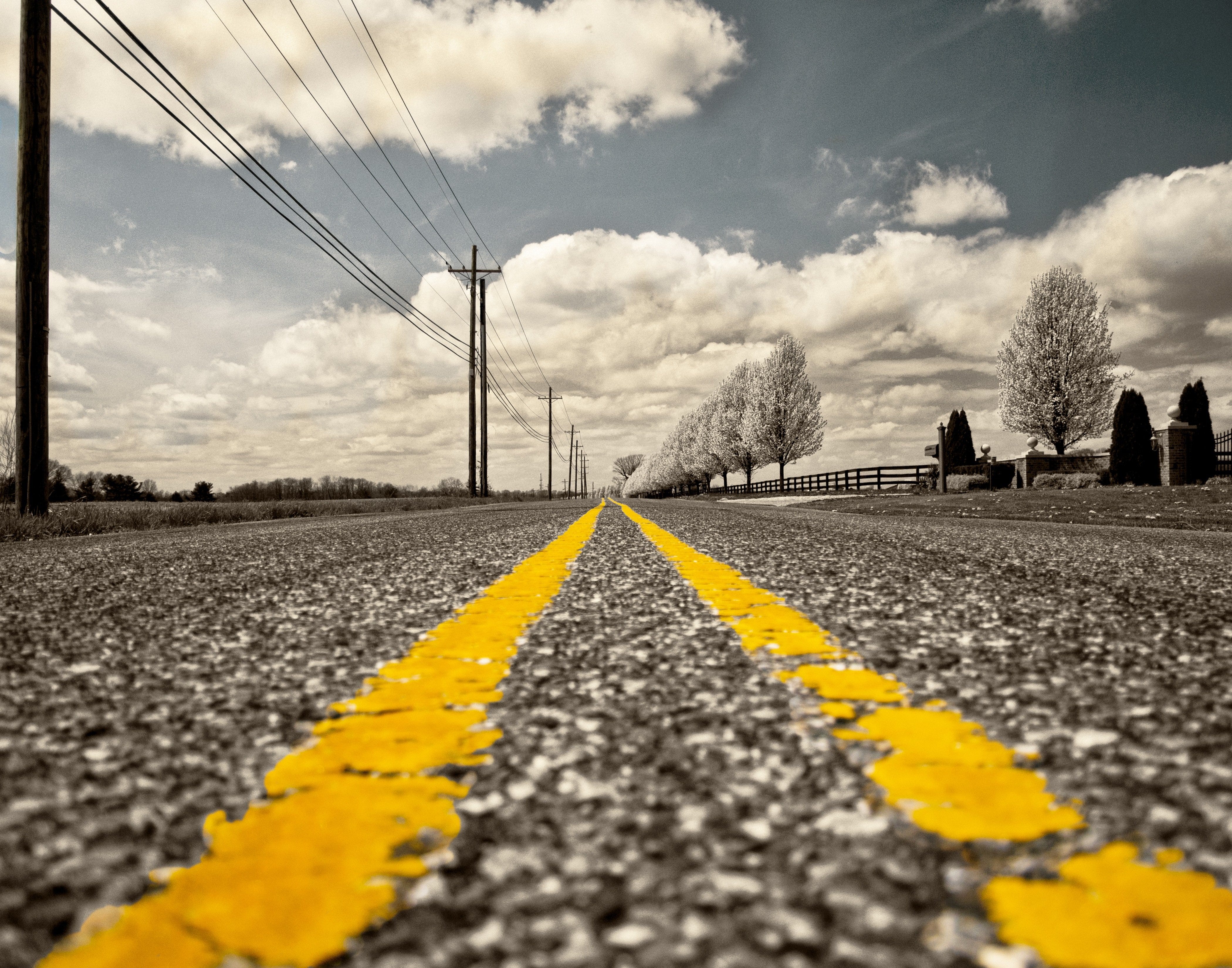
The last time my grandpa and I spoke, it felt like we were two ghosts living double lives, here but gone, together yet separate. Parallel yellow lines. I saw him after our twelve-hour drive, rushing to his reclining chair to kiss his whiskered cheek and rub his hands, and we hugged for a while. I could see how happy it made him by the look on his face, his smile wide like the face of a child. That was the last time I saw him.
I returned home four weeks later and read the eulogy. He didn’t want an open casket, so I touched its shiny black surface, smooth and dark and opaque like the nighttime road, leaving an imprint. We meet each other in the traces, gravel roads, blue highways.
Since my grandpa passed, I wondered if that chapter of the story was over, the chapter about tragedy, the raw and wounded chapter. I know now that I am inventing a different kind of story. It has to do with loving each other while our time here is short.
Very good Julia. Is there more about the mother? Has Ronnie commented? My email: jrhannas@comcast.net (Joyce)
The misty muddy fields that were walked across to rescue those kids left a lingering, cinematic impression. Nicely done. It's interesting too--- it's like you're re-birthing this story, giving it life after so many years. it almost feels like it waited for you.